
Halloween is not my favorite holiday. I don’t like dressing up. I don’t like most horror films. I will never understand paying to enter a house or amusement park or hay bale maze where someone will chase you around and scare you half to death. The only thing I do love about this time of year is that everyone reads ghost stories for a little while.
When I was young, I collected and read them year-round. I would stay up late with my book light and read and read and read until every sound in the dark house sent a shiver down my spine. Anytime we went anywhere for the first time I insisted on a ghost tour – it felt like another way to get to know a city. (A few years ago, I borrowed Ghostland: An American History in Haunted Places by Colin Dickey from the library and it was like Dickey was explaining something I always understood but hadn’t been able to articulate about what ghost stories can tell you about a place and the people who live there.)
This year though I’ve fallen into a rabbit hole of true ghost stories – that is true stories of people and ghosts. It started a few years ago with Erik Larson’s Thunderstruck which touches on how the invention of wireless radio sparked an interest in supernatural communication. If we could send messages across oceans without wires, why couldn’t we reach with other realms? (Larson himself got caught on this idea and ended up writing a ghost story called No One Goes Alone inspired by this area of research – it’s both a great piece of audio fiction and a fictional introduction to a real area of research and investigation from the twentieth century.)[1]
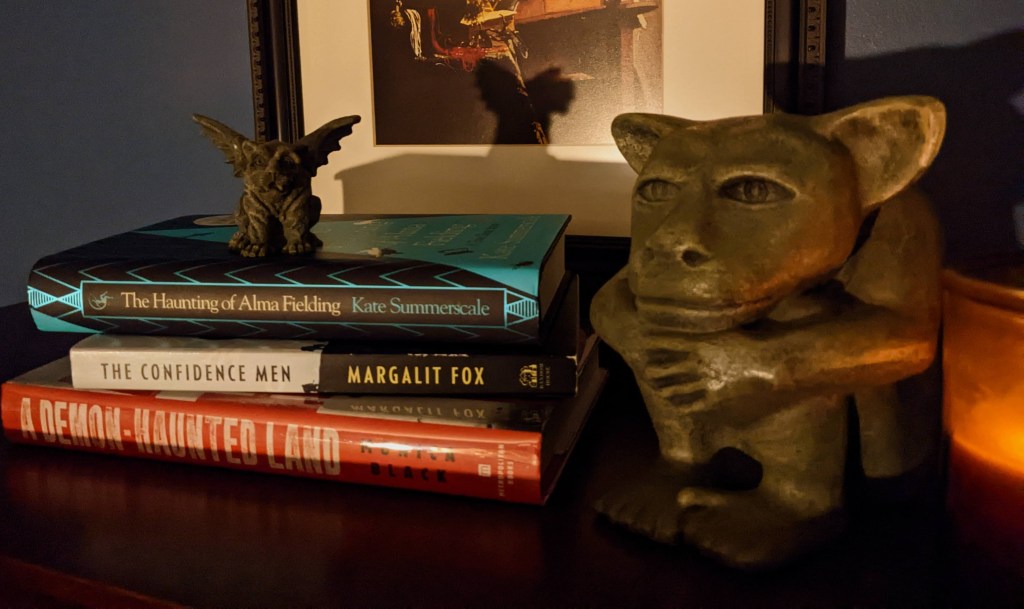
My first real deep dive into a specific case of ghost investigation was The Haunting of Alma Fielding by Kate Summerscale which tells the story of Alma Fielding, a housewife in London and Nandor Fodor who investigates her poltergeist for the International Institute for Psychical Research. Fodor, like the fictional characters in Larson’s narrative, is firm believer in trust – but verify. He believed in supernatural occurrences and spiritualism, but he wanted proof to show others. Fodor is a fascinating figure and Summerscale really delves into how much he wanted this to be true but how he wouldn’t let that cloud his judgment. Fielding as well is an interesting figure to examine. Why did she go through all of this? And why (minor spoiler?!) did she agree to be so closely examined when she was faking it?
The part of that particular ghost story that surprised me the most was Summerscale’s discussion of how interest in spiritualism was connected to different historical events. The first world war created a generation of grieving families looking for a way to contact the dead. Fielding’s husband was plagued with nightmares from his own time in World War I, but Fielding’s haunting was also connected to the outbreak of World War II. Fielding’s first reports of a poltergeist date from 1938 – the stories of her hauntings ran right alongside coverage of the growing crisis in Europe as total war approached Britain.
The Confidence Men by Margalit Fox expanded my interest in the matter further. Fox tells the real story of officers who used the rise of spiritualism to escape a prison camp in World War I. Fox does a great job providing wider context to the story of this particular mission including a discussion of how the American Civil War led to a rise of spiritualism which was only strengthened by the invention of wireless communication. In the end she states that although the officers in The Confidence Men were extremely talented tricksters (their coded language for public readings they held within the camp are insanely detailed and complicated) the reason they were able to pull it off was the perfect combination of time, parties, and location. One of my favorite details of the story is how, in the end, one of our officers, E.H. Jones comes home after the war and writes his memoir with the express hope that he can warn mourning widows and mothers about conmen and tricksters who will try and take advantage of their grief.
These texts are only the start as I continue my ghost hunt. I recently picked up A Demon-Haunted Land by Monica Black which is about supernatural events in Germany following World War II and I’m on the lookout for a text about the Civil War side mentioned in Fox’s book (any suggestions let me know!)
All I know so far is that it’s hard to believe anyone doesn’t believe in ghosts. After all, it would seem we are more than capable of haunting ourselves. No specters or ghouls required.
[1] https://www.nytimes.com/2021/07/29/books/erik-larson-audiobook-no-one-goes-alone.html
 lost in the dust jackets