
First up this month was a library read I was convinced I would love: The Department of Rare Books and Special Collections by Eva Jurczyk. Unfortunately, I’m not sure I would have finished it if I didn’t have the countdown toward its library due date in the back of my mind. There are two really interesting narratives in the book: one about a woman, Liesl, nearing retirement looking back at her personal and professional life and trying to figure out her future and a second about the politics of a university administration when valuable books go missing. Each of those narratives had strong points and the writing was overall very good. There were interesting flashbacks, tense conversations, human heartbreak, and the mystery is resolved in both a sad and believable way. However, the mystery and our main character’s personal story were not combined as well as they could have been. Instead of matching both plotlines, the narrative frequently dropped the mystery of the missing books for several chapters only to pick it up again and drop Liesl’s personal journey which made for a disjointed reading experience.
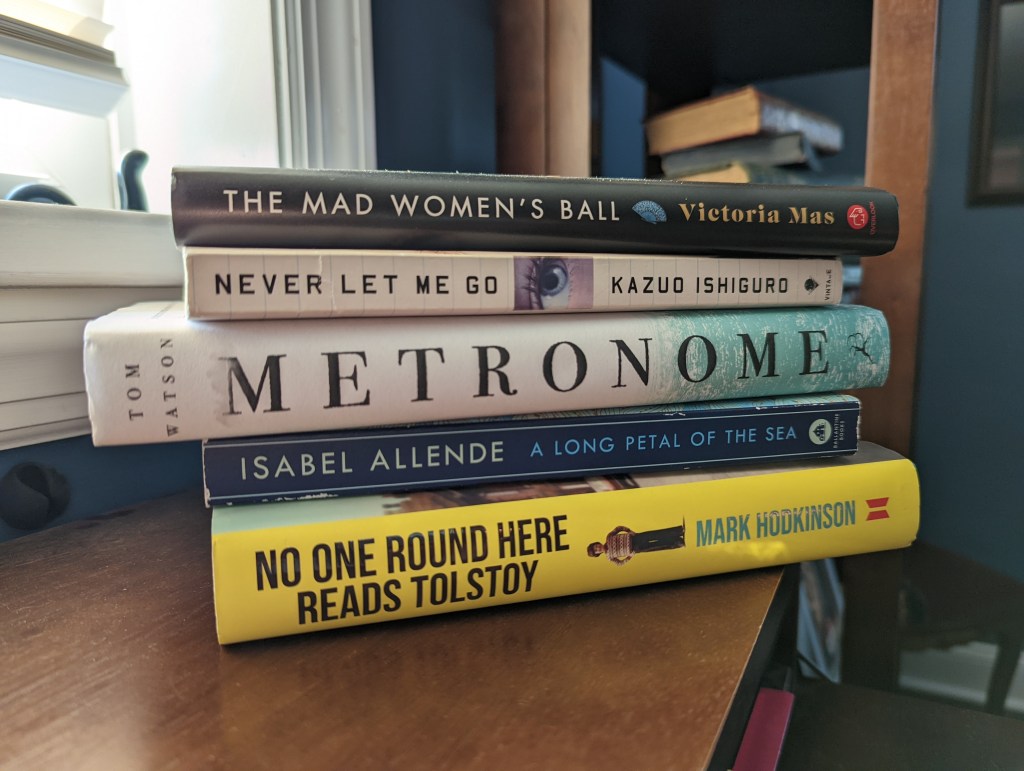
Next up was something I picked up at my local book store: No One Round Here Reads Tolstoy: Memoirs of a Working Class Reader by Mark Hodkinson. This book should have felt a bit chaotic and disorganized because it was doing so many things at once. It’s a memoir about the author’s childhood in a working class family and community in Northern England, it’s a contemplation about being a reader and a book collector, it’s the story of his grandfather’s struggle with mental health issues (and their impact on the rest of his family), and at the end it’s a collection of random thoughts and reactions to some of the books in his collection (a bit like my Book Journal posts). Those are a lot of subjects to cover in one book and it probably should have felt disjointed because of the way he hops around in time, but instead it unfurls itself as more of a living memoir. The truth is, when you get to know someone in your real life rather than off the page it’s rarely in perfect chronological order and Hodkinson trusts his readers to follow him through the maze of his life rather than relying on an organized, structural narrative. I liked this book and I already gave it away to a friend who I know will like it as well– and that’s a wonderful thing.
My book club chose A Long Petal of the Sea by Isabel Allende this month and although I finished it I had so many work responsibilities this week I couldn’t always give it the full attention it deserved so I will be revisiting it again. Allende’s writing covers the full gambit of emotions so completely it’s hard to imagine all that’s contained in just over 300 pages. Her ability to intertwine personal history with global history is well worth taking a moment to appreciate.
Over the long weekend I was eager to get swept away and found two books that were just the ticket. First up was Metronome by Tom Watson. Set in a vague future world full of environmental hazards you are introduced to Aina and Whitney – two prisoners coming to the end of their time on an island prison, until things start to go wrong. I know I usually like to give a good overview but in this case the less detail the better. Watson’s ability to balance the tense, suspenseful tone of the novel while doling out just enough detail and background in each chapter to always keep you engaged.
Next up The Mad Woman’s Ball by Victoria Mas pulled me into the past and broke my heart. Mas takes us into the world of Salpêtrière hospital where women who the world likes to call mad are removed from society except for one night each year when the richest members of Parisian society are brought in to ogle them. Despite the brevity of the novel each character is fully formed and stayed with me long after I closed the book. Perhaps the most interesting distinction of Mas’s work is her choice to focus on the emotional toll of how the women are treated – so many books I’ve read (both fiction and non-fiction) place focus on the physical aspects of life in an asylum (the facilities were usually harsh at best and filthy and full of disease at the worst.) Mas doesn’t ignore the physicality and violence of life in the asylum, but the bulk of the novel focuses on the inner lives of the women and their relationships with each other and the result is well worth it. If you’re looking for something to put on the top of your list, pick this.
After months of picking it up and putting it down, I finished Never Let Me Go by Kazuo Ishiguro. My least favorite of his works that I have read, after much contemplation I think it is because Ishiguro builds such three dimensional and engaging main characters if you don’t connect with them there won’t be much for you in his work. The world he built, and the ethical question at its core, was very interesting in this novel but because the reader is so tied to the narrator, I still couldn’t get into it.
Finally, I finished a very long but good audiobook version of Crime and Punishment by Fyodor Dostoevsky and read by Anthony Heald. A few months ago I bought and briefly started The Sinner and the Saint: Dostoevsky and the Gentleman Murderer Who Inspired a Masterpiece by Kevin Birmingham but quickly realized I wanted to re-read Crime and Punishment first. I loved it in high school and wanted to know if that was still true. It took me much longer to get through this time around (even with Heald reading it to me!) and some of the side plots were a bit less engaging than when I had nothing else to do but read it over Summer break at age 14 but Raskolnikov’s inner moral conflict still pulled me in and I’m glad I went back to the source before I pick up Birmingham’s book again.
 lost in the dust jackets