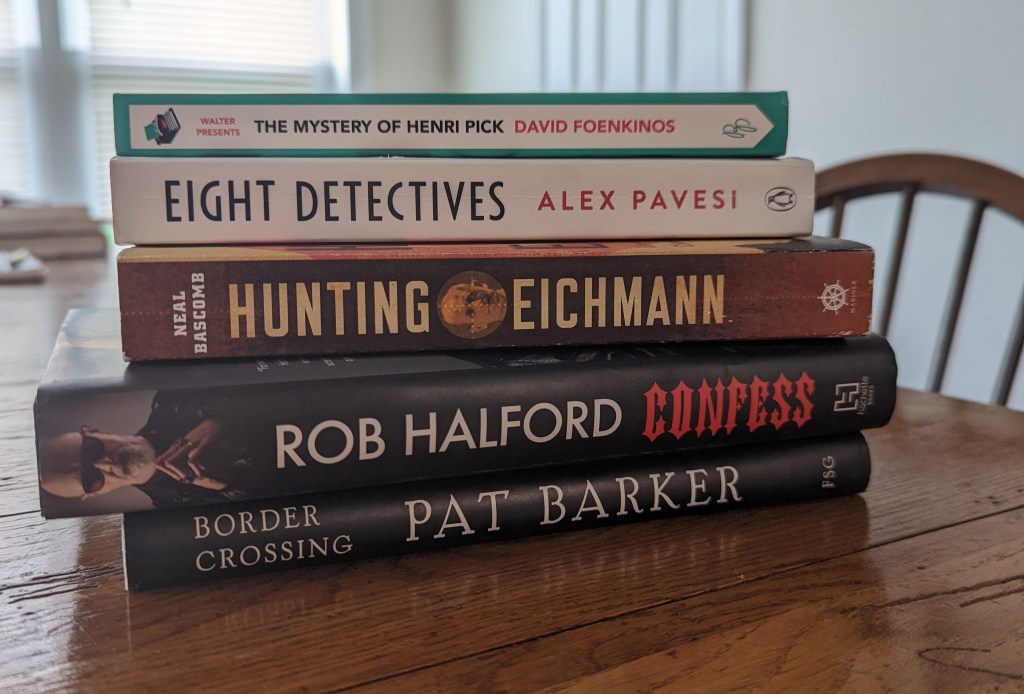
The Mystery of Henri Pick by David Foenkinos (Translated by Sam Taylor) was an engaging trip to literary France. This is a small book full of heart-warming characters and a large literary mystery but it’s also a thoughtful contemplation of the relationship between readers and writers.
Border Crossing by Pat Barker is a short, tense novel about a child psychologist and one of his most memorable cases after a child who went away for murder is grown and released back into society. Barker excels at nuance as she introduces us to a number of characters who knew Danny, the young murderer, at different points in his life and within the British criminal system. Baker pulled me in effectively and it too me only two days to read it cover to cover. Although, I will say Barker’s ability to raise the hairs on the back of your neck I do wish I had finished it during the day rather than the middle of the night.
Confess by Rob Halford was a gift from a friend who loves heavy metal and knows I will give pretty much any book a go – and I’m glad I did. My dad played Judas Priest plenty when I was a kid, so I knew the music, but Halford’s memoir is about a lot more than music. Ho covers just about everything: his childhood, his relationships, his friendships, his life as a gay man. There’s plenty to it and the real magic is that Halford clearly wrote this book himself. Instead of a polished celebrity memoir this is a story told like you’re sitting across from him at the pub with a pint in front of you. It’s funny, emotional, and thoughtful. This was a slow read for me – I’d sit down every few weeks for a chapter or two – but I’m grateful for the time spent in Halford’s company.
I delved back into some twentieth century non-fiction with Hunting Eichmann: How a Band of Survivors and a Young Spy Agency Chased Down the World’s Most Notorious Nazi by Neal Bascomb. Although the cover blurb likens it to a Tom Clancy thriller, I’d argue the strongest aspects of the book were not Bascomb’s detailed descriptions of the spy work but rather the sections detailing the emotional turmoil of immediate post-war era and the mental toll of the war on both individuals and societies. He also overviews Eichmann’s escape from Europe and just how much help he had along the way (for anyone interested in a deep dive in that topic pick up The Ratline by Philippe Sands). The book is full of recently declassified information but perhaps the most intriguing detail is just how many people it took to carry out the mission and how they all kept their secrets.
I also finished a non-fiction audiobook this month, The Color of Law by Richard Rothstein. Rothstein’s attack on the myth of de facto segregation reads like a well-structured argument before the supreme court. He lays out clearly the history, the law, and how the government bodies of the United States (federal, state, and local) continuously violated the Constitutional rights of Black Americans. He also begins the discussion about remedies, but he makes it clear nothing will truly be fixed until the history of de jure segregation is accepted and recognized. This is a must-read for every American.
My final book of the month was Eight Detectives by Alex Pavesi which is both an homage and critique of the murder mystery novel (specifically the early 20th century British iteration). An engaging, fast-paced text full of twists and turns I hope the BBC turns it into an excellent miniseries one day. (Bonus points if they include a cameo by David Suchet).
 lost in the dust jackets