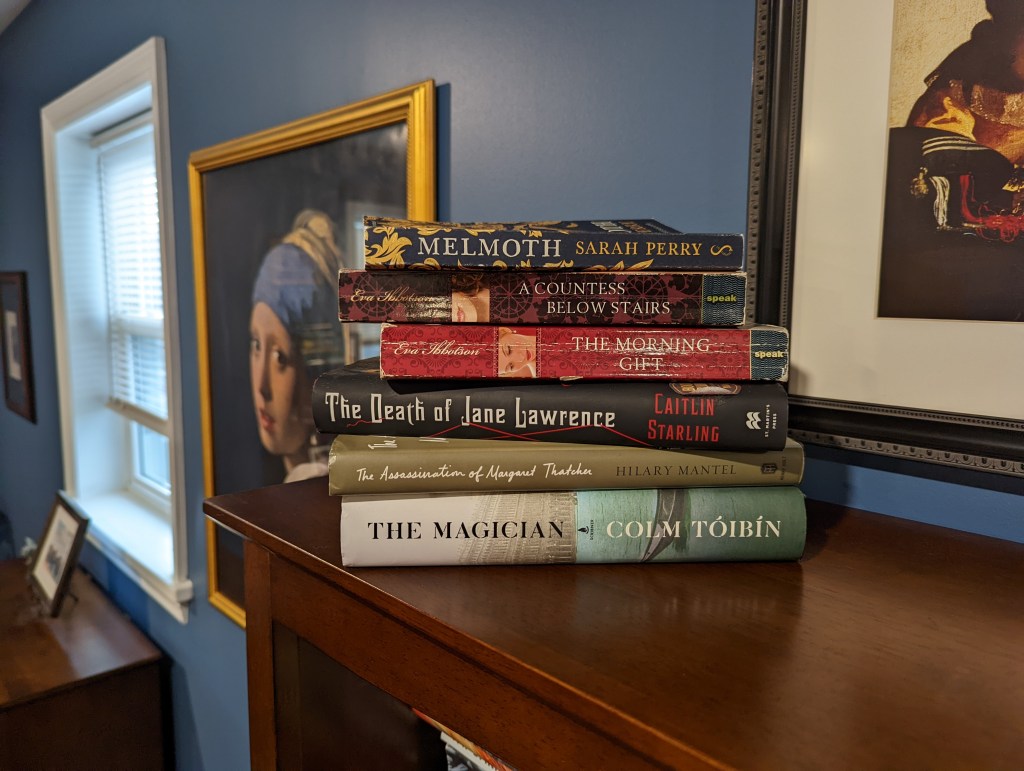
Perhaps the biggest surprise was that I turned back to Eva Ibbotson, who I loved in middle and high school, for an escape and because I was thinking about books I read in my formative years. They are as charming as ever with thoughtful and kind main characters and villains who are often a reflection of the worst of society, not just selfish individuals. It’s no surprise that a kid who grew up reading these still loves a good historical romance novel. Ibbotson’s experience fleeing the Nazis as a child clearly influenced her work where most of her young main characters flee political upheaval and have to build new lives. But it also clearly didn’t destroy her sense of romance or human connection. Her characters face plenty of hardship, but they also find love, friendship, and community.
The main event this month was The Magician by Colm Tobin which I absolutely loved. I did take a week break about 200 pages in (which is when I turned to Ibbotson) but that was mostly to make sure I could give the book the proper attention. There is so much to appreciate about this work. I was able to attend an online discussion with Tobin and he said it’s a book about a marriage. Mann and his wife’s relationship is certainly the backbone of the novel but there have been so many other themes rolling around my mind since finishing it. To me it was also about losing your home and trying to find a new one. History interrupting your life and work and how, depending on your age or your wealth, it means something different to everyone. It was about what it means to be an artist, what it means to be a parent, what it means to be a sibling. Tobin is a fantastic writer but he’s also a passionate reader and when he writes about writers, he wears his reader heart on his sleeve.
Empire of Pain: The Secret History of the Sackler Dynasty by Patrick Radden Keefe was my audiobook of the month. I’ve admired Keefe since listening to Say Nothing: A True Story of Murder and Memory in Northern Ireland and obviously I’m not alone. Empire of Pain won both critical and popular acclaim (and some non-fiction awards) and I can see why. His choice to examine the opioid crisis from the perspective of the family is an important one – distilling the villains of the world to caricatures is never useful. Instead, Keefe shows us how a more normal desire for success and wealth developed into greed and lack of perspective over time across generations. Keefe also shows us how our government and medical community failed to check those capitalist desires. It’s a useful and clear warning we could choose to take to avoid the next crisis in the making. Whether those in power will do so is, of course, another matter.
The final two novels of the month were both dark and a little disappointing. Melmoth by Sarah Perrypromised to be a narrative that crossed time and geographical space. The blurb assured me it was haunting, engaging, and thoughtful with a main character acting as a witness to the dark moments of history. Instead, it was a wonderfully written but gloomy collection of anecdotes with plenty of suffering, sin, and even just evil, but the characters were flat and incomplete so instead of heartbreak it was just grim. The lack of connection with the characters and events left me feeling separate from their choices and challenges. I finished it, but only just.
The Death of Jane Lawrence by Caitlin Starling was also a bit disappointing but for the opposite reason. Starling builds an amazingly creepy atmosphere. I saw a lot of reviewers online commenting on the quick love story but that never bothers me. Once you’ve met people in real life (like I have) who have fallen in love pretty quickly it becomes easier to understand in a novel – especially when your main character has other reasons to get married which is certainly Jane Lawrence’s situation. The disappointment for me came about ¾ of the way through when our period of madness (which any fans of gothic horror know is coming) stretches too long. I do love the ending though – happy but also dark… Overall, even with the slightly disappointing second half, I’m glad I read it and especially appreciated Starling’s open authors note describing the different variations of the novel and its plot.
I finished off the month with the legendary Hilary Mantel’s The Assassination of Margaret Thatcher. Because my relationship with Mantel started with Wolf Hall I think I’ve misjudged her as a writer. Those books are engaging and meticulously researched historical fiction. When I picked up Beyond Black last year, is was such an unusual novel that I am both glad I read but also not sure I’d ever fully recommend to others (especially considering the childhood abuse detailed). This set of tales makes me think maybe Mantel is more of a dark, weird writer and its actually Wolf Hall, Bring Up The Bodies, and The Mirror and The Light which are the outliers in her writing. Although to be fair, maybe that darkness is why she so successfully wrote about such a violent and brutal period of British history… either way I’m not done with her. She always pulls me in and surprises me. What more can you ask for from a writer?
 lost in the dust jackets